Sheetmusic Terminology
A visual glossary of the notation elements Sheetmusic4J renders, so you can point at something in a screenshot and know exactly which class/method is responsible for it. Rendered from fxdemo/src/test/resources/xmlsamples/SchbAvMaSample.musicxml (Schubert’s Ave Maria), the same fixture used throughout development.
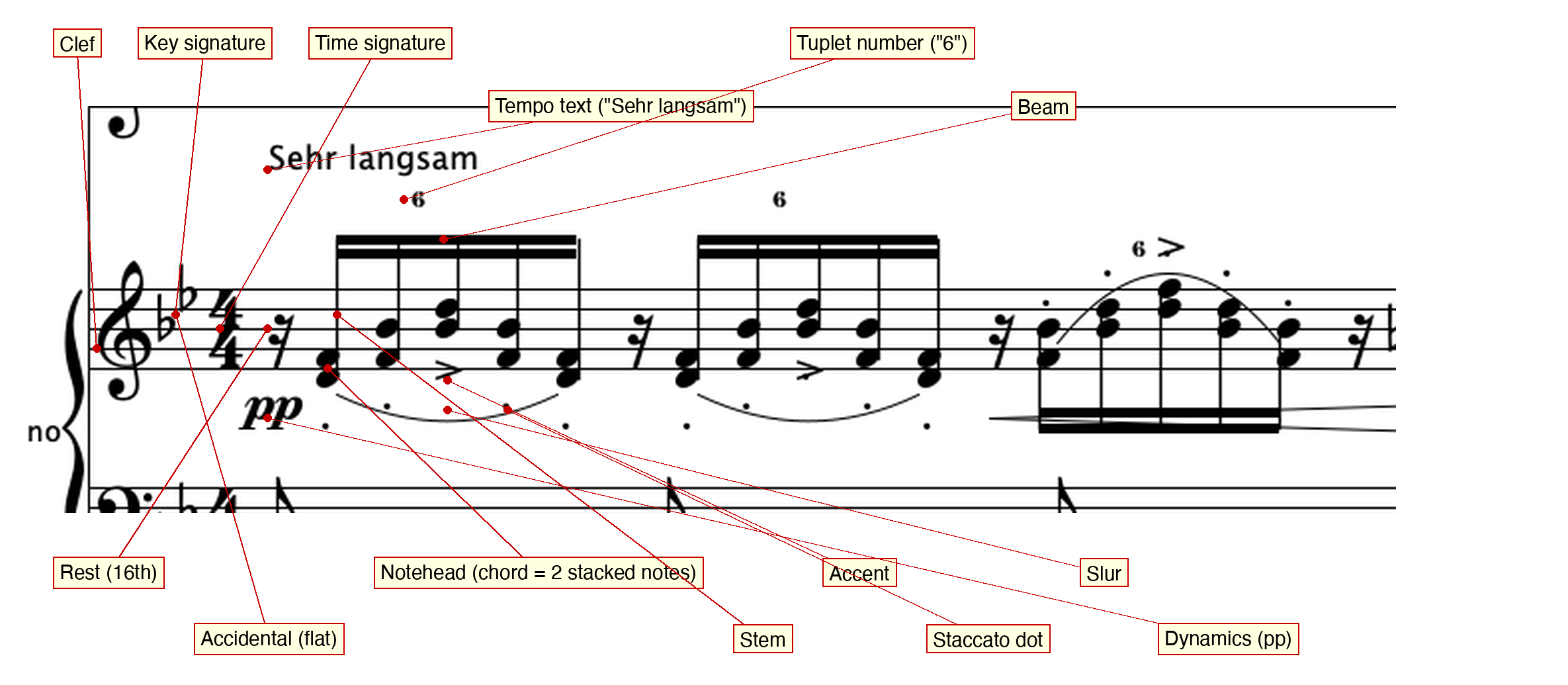
How to Use This When Reporting a Difference
Instead of “the horizontal line above the notes is too low”, say “the beam is too low”, then check the table below for Beam to jump straight to Engraver.computeStemTips / naturalStem. The goal is to skip a round of “what do you mean by X” every time something looks off.
Element Reference
Every element flows through the same three layers: MusicXML to core model to engraving layout to painter. The table gives the concrete name at each stage.
| Element | What it looks like | MusicXML source | Core model (core) | Layout (engraving.Engraver) | Placement type | Drawn by (fxviewer.ScorePainter) |
|---|---|---|---|---|---|---|
| Clef | Treble/bass symbol at the start of a staff | <clef> | Clef, ClefSign | clefGlyph(), clefAnchorLineIndex() | GlyphPlacement (CLEF_G/F/C) | drawGlyph |
| Key signature | Sharps/flats after the clef | <key><fifths> | KeySignature | placeKeySignature(), KeySignatureLayout | GlyphPlacement (ACCIDENTAL_SHARP/FLAT) | drawGlyph |
| Time signature | e.g. 4/4 after the key sig | <time> | TimeSignature | placeTimeSignature() | GlyphPlacement (TIME_DIGIT_0…9) | drawGlyph |
| Barline | Vertical line ending a measure/system | implicit / <barline> | (none) | measure loop in layoutStaffRow; SystemBarline | SystemBarline | drawSystemBarline, drawStaff |
| Measure (bar) | Horizontal span of music between two barlines | <measure> | Measure | measure loop in layoutStaffRow; sharedMeasureMinWidths() | (implicit, bounded by two SystemBarlines) | (none) |
| Notehead | The oval note head itself | <note><type> | Note, NoteType | noteheadGlyph(), placeNote() | GlyphPlacement (NOTEHEAD_BLACK/HALF/WHOLE) | drawGlyph |
| Chord | 2+ noteheads stacked at the same beat | <chord/> | Chord (wraps List<Note>) | placeElement() Chord branch | multiple GlyphPlacements, one shared StemPlacement | drawGlyph x N |
| Stem | Vertical line from a notehead | implicit, or explicit <stem>up/down</stem> | Note.stemUp() | naturalStem(), computeStemTips() (run-wide flattening + ledger-line clearance), placeNote() | StemPlacement(x, y1, y2) | drawStem |
| Beam | Thick bar(s) joining stems of short notes | <beam number="N">begin/continue/end</beam> | Beam, Beam.State | processBeams(), computeStemTips() | BeamPlacement | drawBeam |
| Flag | Curly tail on an unbeamed 8th/16th note | implicit from <type> when not beamed | (none) | flagGlyph() | GlyphPlacement (FLAG_8TH/16TH_UP/DOWN) | drawGlyph |
| Accidental | Sharp/flat/natural directly before a notehead | <accidental> (explicit only, see note below) | Accidental, Note.displayedAccidental() | accidentalGlyph(), hasAccidental() | GlyphPlacement (ACCIDENTAL_*) | drawGlyph |
| Augmentation dot | Small dot after a note/rest, extends duration | <dot/> | Note.dots() / Rest.dots() | dot loop in placeNote()/placeElement() | GlyphPlacement (AUG_DOT) | drawGlyph |
| Rest | Symbol for a silent beat | <rest/> | Rest, NoteType | restGlyph(), restAnchorStaffStep() | GlyphPlacement (REST_WHOLE…REST_128TH) | drawGlyph |
| Tuplet number/bracket | Small italic count (e.g. “6”, “3”) over/under a grouped run | <time-modification> + <notations><tuplet> | TimeModification, Tuplet | updateTupletCandidates(), TupletRun (tracks the run’s pitch extreme) | TupletPlacement | drawTuplet |
| Slur | Curved line over/under a phrase (different pitches) | <notations><slur> | Slur, Slur.Placement | slur matching in placeNote(), SlurStart (tracks pitch extremes spanned) | SlurPlacement | drawSlur |
| Tie | Curved line joining two notes of the same pitch | <tie type="start/stop"/> | Note.tieStart()/tieStop() | tie matching in placeNote(), PlacedNote | TiePlacement | drawTie |
| Articulation, staccato | Dot directly above/below a notehead | <notations><articulations><staccato/> | Articulation.STACCATO | articulation loop in placeNote() | GlyphPlacement (ARTICULATION_STACCATO) | drawGlyph |
| Articulation, accent | > mark above/below a notehead | <notations><articulations><accent/> | Articulation.ACCENT | articulation loop in placeNote() | GlyphPlacement (ARTICULATION_ACCENT) | drawGlyph |
| Dynamics | pp, mf, ff, … | <direction-type><dynamics> | DynamicMark, DirectionType.Dynamic | placeDirection() Dynamic branch, dynamicGlyph() | GlyphPlacement (DYNAMIC_*) | drawGlyph |
| Hairpin | Opening/closing wedge (cresc./dim.) | <direction-type><wedge> | DirectionType.Wedge, WedgeType | placeDirection() Wedge branch, WedgeStart | HairpinPlacement | drawHairpin |
| Tempo / words text | e.g. “Sehr langsam” above the staff | <direction-type><words> | DirectionType.Words | placeDirection() Words branch | TextPlacement (MarkingCategory.DIRECTION) | drawText |
| Metronome mark | e.g. quarter note = 60 | <metronome> | DirectionType.Metronome | placeDirection() Metronome branch, metronomeText() | TextPlacement (MarkingCategory.TEMPO) | drawText |
| Rehearsal mark | Boxed letter/number (A, B, 12…) | <rehearsal> | DirectionType.Rehearsal | placeDirection() Rehearsal branch | TextPlacement, boxed (MarkingCategory.REHEARSAL) | drawText |
| Chord symbol | Guitar/piano chord name above the staff (Cmaj7…) | <harmony> | Harmony, HarmonyKind | placeHarmony() | TextPlacement (MarkingCategory.CHORD_SYMBOL) | drawText |
| Lyrics | Syllables under a vocal line | <lyric> | Lyric, Syllabic | placeLyrics() | TextPlacement (MarkingCategory.LYRIC) | drawText |
| Brace / bracket (“accolade”) | Curly/square brace grouping staves at the left | <part-group>, or implicit for a multi-staff part (e.g. piano grand staff) | PartGroup, GroupSymbol | grand-staff brace + <part-group> bracket logic in layout() | BracketPlacement | drawBracket |
| Part label | Instrument name at the left of a system (e.g. “Piano”) | <part-name> / <part-abbreviation> | Part | emitPartLabel() | TextPlacement (MarkingCategory.PART_LABEL) | drawText |
Notes on a Few Non-Obvious Rules
- Accidentals are never inferred from pitch. A note’s
alter(e.g. -1 for flat) only encodes the sounding pitch, it does not mean the flat should be drawn. Only an explicit<accidental>element in the source causes a glyph to appear. This matches standard MusicXML: the authoring software already decided where accidentals are visually needed (key signature, courtesy, previous note in the measure) and encodes that decision directly. - Stem direction prefers the explicit
<stem>element over a pitch-based guess, because a beamed run can span notes on both sides of the staff’s middle line, so guessing per note independently can flip direction mid-beam. - A beamed run shares one stem length, computed from the highest/lowest notehead across the entire run (not each note’s own pitch), so every stem reaches the same beam height instead of some falling short.
- Slurs track the pitch extremes of every note they span (not just their two endpoints), so a phrase that arcs up to a peak and back down gets a curve that clears the peak instead of cutting through it.
- Tuplets and slurs both use MusicXML’s
numberattribute to pair astartwith its matchingstopwhen several are nested/concurrent. - “Measure” and “bar” are the same thing, the horizontal span between two barlines. Measure is the American term, bar the British one; the codebase uses
Measurethroughout (mirroring MusicXML’s<measure>), but bug reports and issues may use either interchangeably.
Source: docs/NOTATION_ELEMENTS.md in the Sheetmusic4J repository.